
Blog #6: A Faucet is a Hole
01 February 2026
Overview
I advocate for a mechanistic understanding of our world. Not only does it vastly enhance learning and creativity, but it also dispells superstition while maintaining a near-spiritual admiration of our world.
Case Study: Faucets
When Meaghan and I first moved into our condo for grad school, we redid our bathroom. I know the right end of a screwdriver, but I'm not the handiest for home DIY projects. It was my first time changing a faucet, from a crummy chrome original to a modern matte black. Very sophisticated.
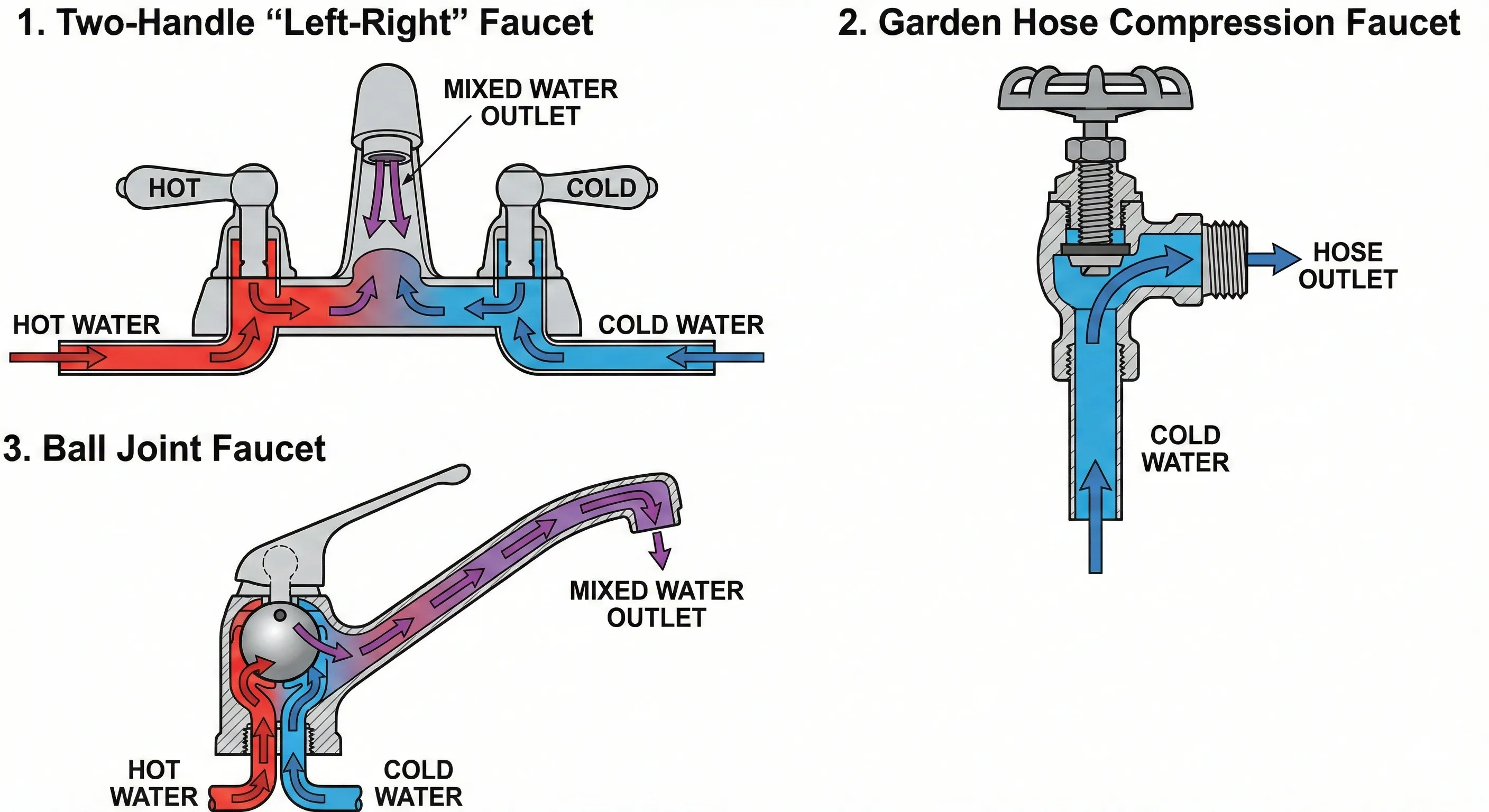
Upon removing the old faucet, I realized that the mechanism is just two obstructed holes, one for cold water and one for hot. By rotating a handle, the seal of the line opens. Turn it a little, and the opening is small, so there isn't much flow. Open it fully, and the flow is greater. The temperature is simply controlled by the relative amounts of hot and cold water mixing in the faucet. All valves work via this mechanism: control flow and pressure via physical obstruction.
This simple fact, obvious in hindsight, leads to a number of revelations. For such a mechanism to work, all valves of the house must be under constant pressure. There is no "summoning" of water by turning a faucet. The water is always there, trying to force its way out. When a house floods from a leak in a toilet or washing machine line, it's because every line under the house is under strong pressure at all times.
It also reveals that faucets of different design really just differ in the method of physical obstruction: a single-handle faucet is a ball joint with an opening at one angle for the hot line and another for the cold line, a compression faucet (like a garden hose) uses threading to increase or decrease a vertical gap as it twists.
James is Bad at DIY, What's the Point?
My point is that everything is much more interesting and cohesive than at first glance, even something as mundane as a faucet. It's a small hop to go from how faucets control water flow to how switches control current in an electrical circuit. Indeed, current is meaningful in water and electricity: amps are like gallons per minute. If we think of an aqueduct that uses gravity to deliver water, voltage is like the difference in height between the start and end points, or the pressure in the lines. Resistance is like friction in a pipe, a resistor is a choke point that restricts flow and causes a drop in pressure across it (just as voltage drops across a load), and so on.
Once the mechanism is understood, the need to memorize fades away. And the ability to grok related concepts blossoms. Understanding a faucet can help you understand electricity. The circulatory system has its own jargon (cardiac output, blood pressure, stroke volume) but it's all simple hydraulics, just like a faucet. When I took medical physiology my first semester of PhD, we used the math of springs to model the lungs. Reduce, reuse, recycle.
No Black Boxes
Let's talk about input-output machines, or black boxes. A black box is a tool whose inner workings are obscured or mysterious. Refuse black boxes in all aspects of life. I know, it's ironic for the guy who loves machine learning to say this, but there's a clean distinction, a separating hyperplane. Deep learning is quite simple! Yes, we cannot easily say which features even a small neural net is using to succeed at its task, but we understand the mechanism by which it learns thoroughly. We can understand how faucets work without understanding the minutiae of fluid dynamics. Indeed, fluid dynamics is still one of the most chaotic, under-modeled areas of classical physics.
So when I say "no black boxes," I am calling for a war against the laziness of input-output machines. In modern bench biology, we often use kits for simple methods like DNA extraction, polymerase chain reaction (PCR), or even gene knockout. These kits come with easy instructions, and proprietary concoctions labeled with arcane names like P1, reaction buffer, or the loathsome "master mix." I'm lucky to be originally trained in a chemical biology lab, where we made all of our buffers and methods largely from scratch. Even as a teenager, I understood why we add salt and ethanol to precipitate DNA, why adding EDTA increases stability of DNA, why too much EDTA can interfere with downstream enzymes, and so on.
I was shocked to find many of my biology-only colleagues had no idea how or why these kits worked. When something goes wrong, they cannot troubleshoot effectively, or even worse, they misinterpret mistakes as biological signal (see Blog #2 for a full example). Further, they are unable to create new methods because they don't even understand the old ones! This adherence to black boxes in biology makes it one of most superstitious natural sciences I'm aware of, and it leads to incredible inertia: "because that's how we've always done it." Next time someone provides that as an answer, ask them this simple question: what's the mechanism?
The Demon-Haunted World
“Science is not only compatible with spirituality; it is a profound source of spirituality.”
- Carl Sagan
When I explain my approach to life of constantly seeking out the how and why, some people respond with "you're taking the magic out of the world!" I feel this is furthest from the truth. The ability to predict future events is magic. Understanding the universe operates off a handful of simple principles is magic. Knowing the stars in the sky are massive fusion reactors so powerful that I can see them lightyears away is magic. Feeling that a parent who dies is always with you through the manifolds of behavior they molded in your brain and the very DNA in your cells is magic. Our universe becomes more amazing the more we understand it, not less.
And what is the alternative? Consider the living nightmare of our ancestors. Put yourself in the sandals of a young person selected for human sacrifice, praised by your family since your death will ensure another year with sunrises. Or being so afraid of black magic that the thighbone of a jaguar pointed at you by an angry spiritual leader sends you into shock, affirming the bad medicine for generations. Or more recently, the use of the radical mastectomy for decades which did not improve breast cancer survival rates whatsoever but often left women permanently disabled.
Now consider the uninterrupted chain of ancestors struggling against and surviving in that hateful, random, superstitious world so we may finally understand it. I intend to do just that.
James